
grading
The grading bottleneck: why you can’t just "grade faster" your way out
Most "grade faster" advice addresses one of four taxes on your time. Knowing which tax you’re actually paying is the difference between an evening saved and another Sunday lost.
 Enzo · June 2, 2026 · 9 min read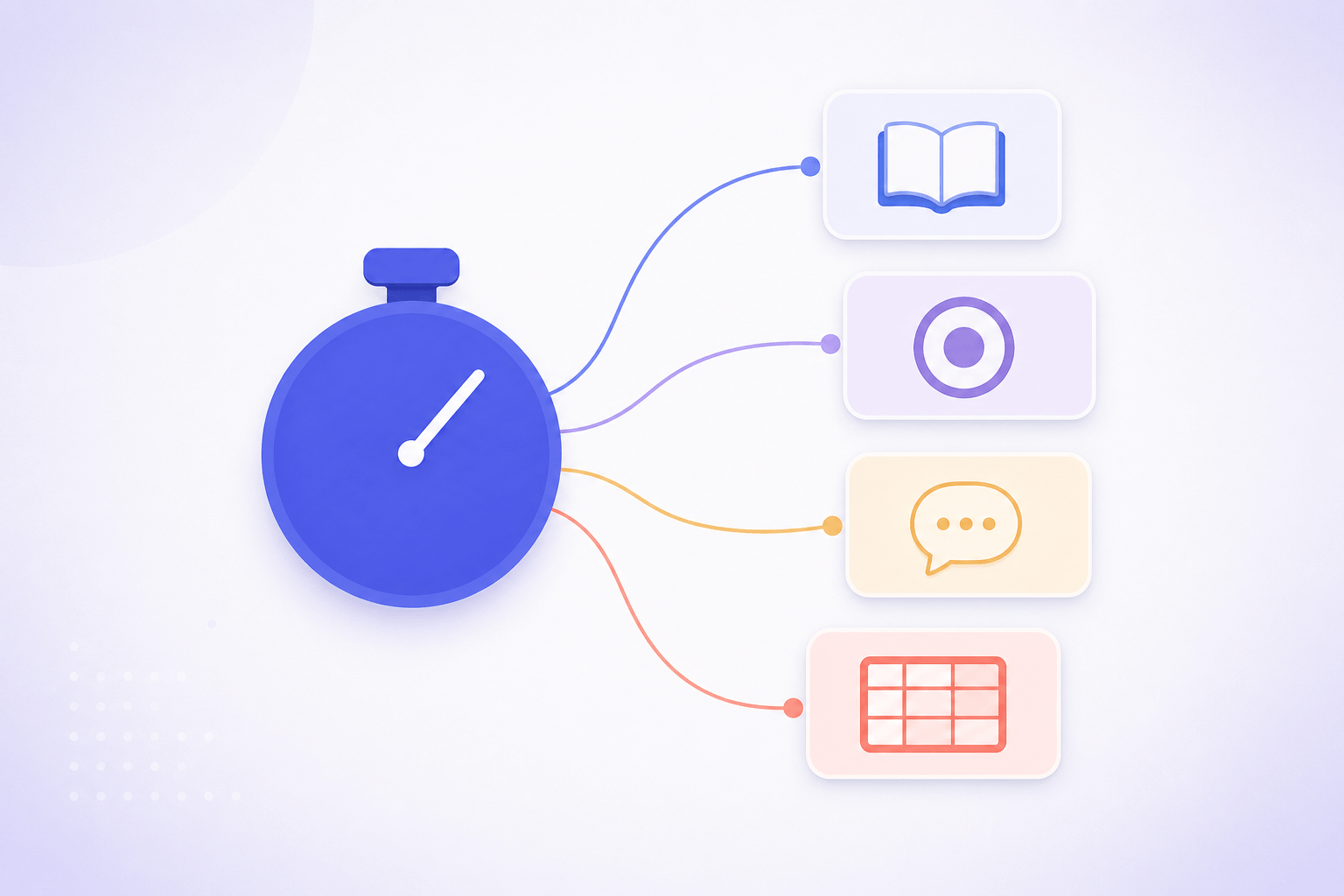
Every "how to grade faster" post on the internet shares one structural flaw: it treats grading as a single task, then suggests a single fix. Set a timer. Use a rubric. Drink coffee. Do five papers, take a break, do five more. The problem is that grading is not one task. It is four tasks stacked on top of each other, and most of the popular fixes only attack one of them. That is why teachers can adopt every hack on Reddit and still be grading on Sunday night.
I want to make this concrete. There are four distinct time-costs in grading, I will call them taxes, and each one responds to different fixes. Once you know which tax is actually eating your evening, you can attack the right one.
The numbers, just so we agree this is real
A 2025 survey by Perspectus Global for Learnosity found that US teachers spend 9.9 hours a week marking, with 95% taking grading work home and a third saying they considered leaving the profession in the past year because of grading workload alone. The UK number from the same instrument is 8.2 hours per week, with 87% taking it home and 52% having considered leaving. These are not "I'm tired" numbers. These are "this job structurally has a bottleneck" numbers.
The Education Support 2025 Teacher Wellbeing Index, the ninth annual edition of the UK's largest teacher survey, recorded the lowest overall wellbeing score since the survey began in 2019. Workload was the leading driver. The marking pile is one of the heaviest contributors. Teachers know this. The hacks aren't keeping up.
The four taxes on your grading time
Tax #1: Reading
You have to actually read what the student wrote. This is the only tax that's pure teaching, the only one where you're doing the thing you went into the profession to do. For a 30-paper batch with 500-word essays, this is roughly 60-90 minutes, depending on subject. It is not the bottleneck. It is the part that should not be compressed.
Tax #2: Scoring
After reading, you assign a score. This is where rater drift and decision fatigue live. The Wolfe et al. meta-analysis of 435 educational feedback studies in Frontiers in Psychology found a medium effect size (d = 0.48) for feedback overall, but a striking finding: one-third of studies showed negative effect sizes. Feedback that was rushed, evaluative-without-explanation, or inconsistent across the batch actually hurt student achievement. Speed at this stage costs more than time.
Tax #3: Feedback writing
After scoring you write something. A comment, a margin note, a one-line summary at the bottom. The Wolfe meta-analysis is brutal here too: feedback that's "informative rather than evaluative" produces gains; feedback that's just a number with a platitude does not. Writing useful comments takes longer than writing useless ones. For a 30-paper batch, useful feedback is another 30-60 minutes on top of scoring.
Tax #4: Data entry
After all that, you have to get the scores into your gradebook. Type each name. Type each score. Open three tabs. Cross-reference. Double-check. This is the most invisible tax and the one that quietly grows over a term. It is not teaching. It is not even assessment. It is administrative friction.
What each popular hack actually addresses
Once you separate the taxes, you can be honest about what each piece of "grade faster" advice does:
- Set a timer. Reduces tax #1 (reading time) at the cost of accuracy. Sometimes worthwhile for low-stakes formative work; never worthwhile for graded assessments.
- Use a rubric. Reduces tax #2 (scoring time) by anchoring decisions. This is the highest-value habit on the list. A clear rubric also reduces drift, which is the hidden cost of tax #2 across a batch.
- Comment banks / canned phrases. Reduces tax #3 (feedback writing) by templating common notes. Useful when paired with one custom sentence per student. Useless if it produces 30 identical comments.
- Caffeine, music, working in chunks. Reduces fatigue, marginally improves all four taxes, addresses none of them structurally. The Ackerman & Kanfer line of research on cognitive fatigue in repetitive tasks shows that pushing through fatigue improves response time but increases error rate. You finish faster and mark less consistently. That trade is the opposite of what you want.
- Grade with a friend. Reduces tax #2 by anchoring you to a peer's interpretation. Real upside if your school does formal moderation. Often impractical for solo subject teachers.
Notice what's missing from that list: nothing reduces tax #4 (data entry). Most gradebooks still require manual transfer, which is roughly 15-20 minutes per 30 papers if your handwriting is legible to your future self. That's an hour a week, in most teaching loads, of pure wasted time.
The thirty-paper benchmark
I run this calculation honestly with new colleagues all the time. Thirty 500-word essays, MYP English. Real numbers from my own time-tracking when I was teaching:
- Tax #1 (reading): 75 min
- Tax #2 (scoring with a clear rubric): 30 min
- Tax #3 (feedback writing, one targeted comment per paper): 45 min
- Tax #4 (data entry into ManageBac): 20 min
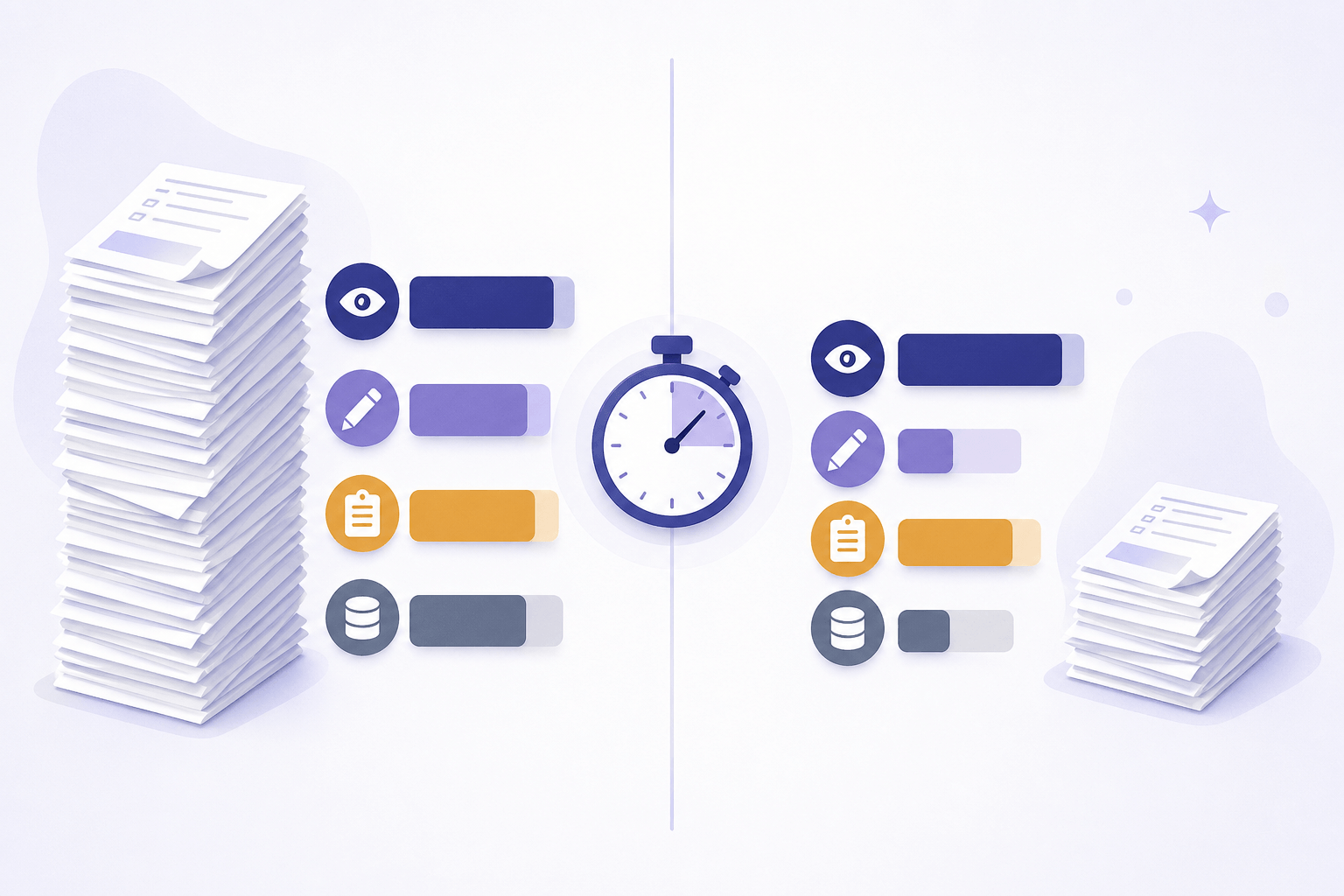
That's 170 minutes. Just under three hours, for a class of 30. Multiply by four classes a week and you have twelve hours of grading. Add the curriculum-design tax, parent comms, lesson prep, and the school musical, and you're at the structural cap on teacher hours per week before you've taught a single live lesson.
Now look at what AI actually changes about each tax:
- Tax #1 (reading): unchanged. You still read the paper.
- Tax #2 (scoring): can be largely automated if the rubric is locked across the batch. We covered the locked-rubric question in detail in the locked-rubrics post; the short version is that this is the single biggest change AI can make.
- Tax #3 (feedback): can be drafted by AI, edited by you. The Wolfe meta-analysis warning still applies - generic feedback hurts. AI is good at proposing the starting sentence and bad at the closing one. You write the closing one.
- Tax #4 (data entry): largely eliminated by structured-output tools. Scores go straight to a CSV that your gradebook accepts. This single change is worth as much as Tax #2 in absolute time, even though data entry rarely gets its own headline.
That's why the 30-paper benchmark with the right tools drops from 170 minutes to something closer to 90 minutes, with most of the savings coming from taxes #2 and #4 (the most boring of the four). You're still reading the papers. You're still deciding the scores. You're just not doing the same scoring decision thirty times and not typing scores into a gradebook one row at a time.
The harder question under the stack
Behind all four taxes is a structural question that almost no school has good answers to: why are teachers expected to grade so many papers? Are they all formative? Are they all summative? How many of them is anyone actually using? The NASUWT 2025 Big Question survey found that only 12% of UK teachers agreed their school had a clear policy on the right to switch off in the evenings (NASUWT, 2025). That's a structural-leadership problem, not a teacher-discipline problem.
Until that gets solved at the policy level, the realistic question for an individual teacher is: which of my four taxes is the heaviest, and what's the smallest change that reduces it? For most teachers, the heaviest tax is #4 (data entry), and the smallest change is using any tool that exports a CSV. For a smaller number, the heaviest is #2 (scoring drift across a batch), and the smallest change is writing a clearer rubric. Both are worth your effort. Neither is the timer trick.
The reason "just grade faster" feels useless is that it usually is. The bottleneck isn't your speed. It's the structural shape of the four-tax stack. Knowing which tax you're paying tells you which fix to try first.
Sources cited above: Learnosity / Perspectus Global, US and UK teacher marking surveys, March-April 2025; Education Support, Teacher Wellbeing Index 2025; NASUWT The Big Question 2025; Wolfe et al., Frontiers in Psychology, "The Power of Feedback Revisited"; Ackerman & Kanfer cognitive-fatigue research, PLOS ONE.