grading
AI grading vs. ChatGPT: a teacher’s honest comparison
I tried ChatGPT for a term of grading before I built anything. Here is what worked, what broke, and where a dedicated AI grading tool earns its place over a general chatbot.
 Enzo · May 5, 2026 · 9 min read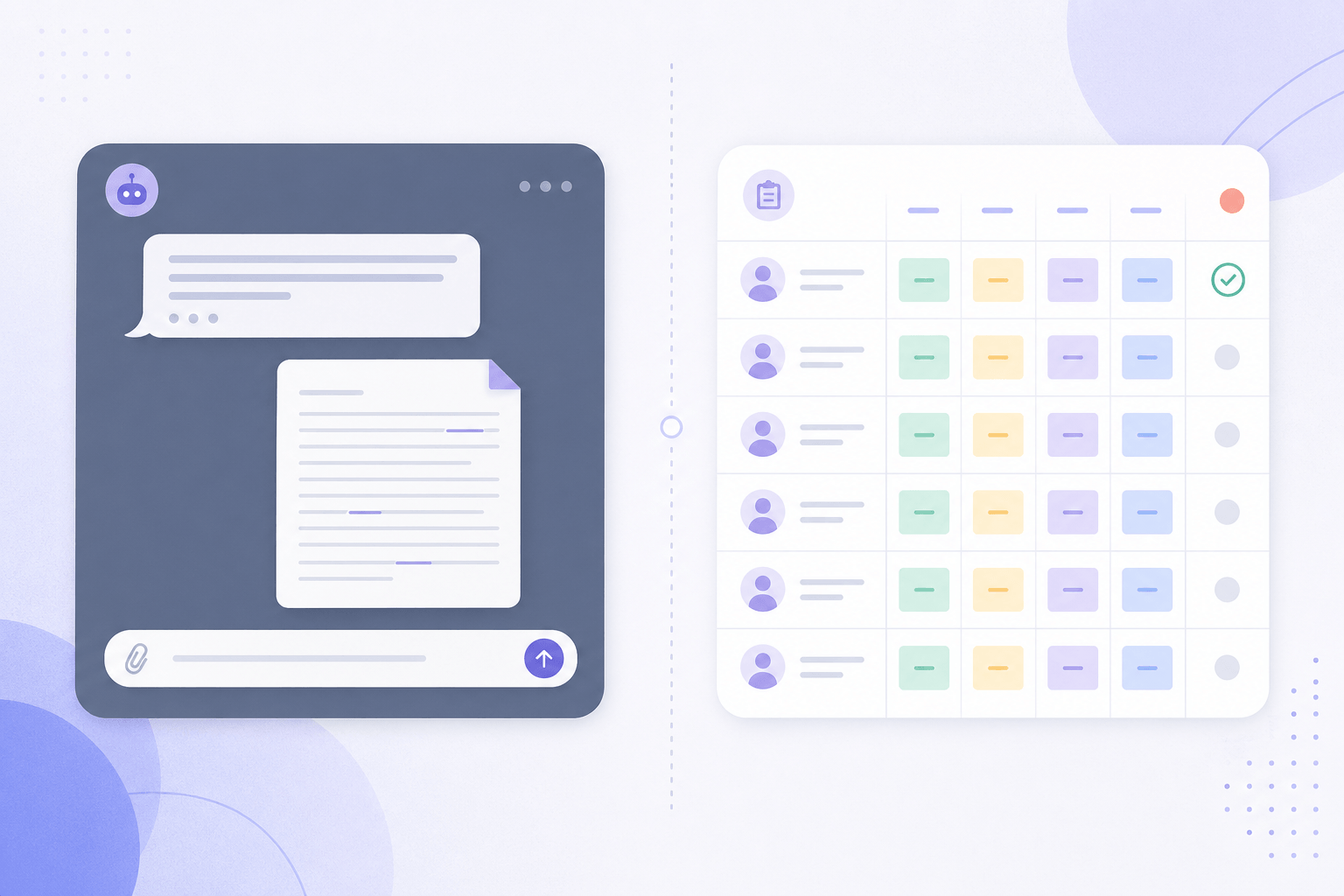
I want to start with the honest case for ChatGPT, because the rest of this post is going to argue against using it for grading and I do not want to be a hater about it. I used ChatGPT for nearly a full term before I built anything of my own. It is genuinely useful. It is fast. It is free at the level most teachers will hit. It is also, for grading specifically, a tool that quietly costs you back most of the time it seems to save. The right comparison is not "AI versus no AI." It is "general chatbot versus a tool built for the job."
That comparison has shifted recently, because the data on how teachers actually use general AI for grading is finally coming in.
What teachers are actually doing with general AI in 2026
The OECD’s Digital Education Outlook 2026 and TALIS 2024 results are the cleanest snapshot we have. Of teachers who report using AI at all, only 26% use it to assess or mark student work. That is the lowest-ranked use case across 55 education systems surveyed. Lesson planning, slide decks, summarising articles, drafting emails, those all rank higher. Marking comes last.
It is not that teachers haven’t tried. The RAND Corporation’s AI Use in Schools survey found teacher AI use jumped roughly 15 percentage points or more in a single year, and explicitly listed grading as one of the documented uses, alongside writing recommendation letters and drafting administrative copy. Teachers tried general AI for grading. Some of them stuck with it. Most of them did not. The OECD number is the result of that pruning.
The consistency problem: same paper, different grade
The single most useful study I read this year on this question is Per Flodén’s 2025 paper in the British Educational Research Journal, which graded 463 university exam responses through ChatGPT against human teachers and then re-graded the same papers again to test consistency. Two findings worth quoting verbatim.
70% of ChatGPT’s gradings were within 10% of the teachers’ gradings and 31% within 5%.
That sounds reasonable until you see the consistency number. When the researchers fed the same exact paper back to ChatGPT a second time:
31.2% of initial grades changed upon re-evaluation, with 25.7% changing by more than one grade level.
Read that twice. One in three papers got a different grade the second time through. One in four shifted by a full grade band or more. ChatGPT also tended to give marginally higher scores than the teachers, which is a separate, smaller problem (Flodén 2025). The scale of the inconsistency is the headline.
If you are using ChatGPT to grade thirty papers in thirty separate windows, you are going to push back the very problem most teachers reach for AI to solve, the consistency problem.
The supervision tax that eats the savings
The other reality of using a general chatbot is that you cannot trust the output without checking it. EdSurge ran a piece in March 2026 where they interviewed teachers across multiple districts on AI use; one of the cleanest quotes in there is worth keeping in mind whenever a vendor pitches you their AI grader:
I think it’s very useful if you know your content very well. If you don’t know your content, it’s hard to tell whether or not it’s accurate. (EdSurge, March 2026)
Translate that to grading: if you grade thirty papers with ChatGPT, you have to read each paper closely enough to verify the AI’s call before it goes onto the report card. That is most of the work you were trying to skip. The AI gave you a draft, not an answer. For lesson planning that is fine, the supervision tax is small. For grading the tax is huge, because every score you skim past is a parent meeting waiting to happen.
What a dedicated AI grading tool actually does differently
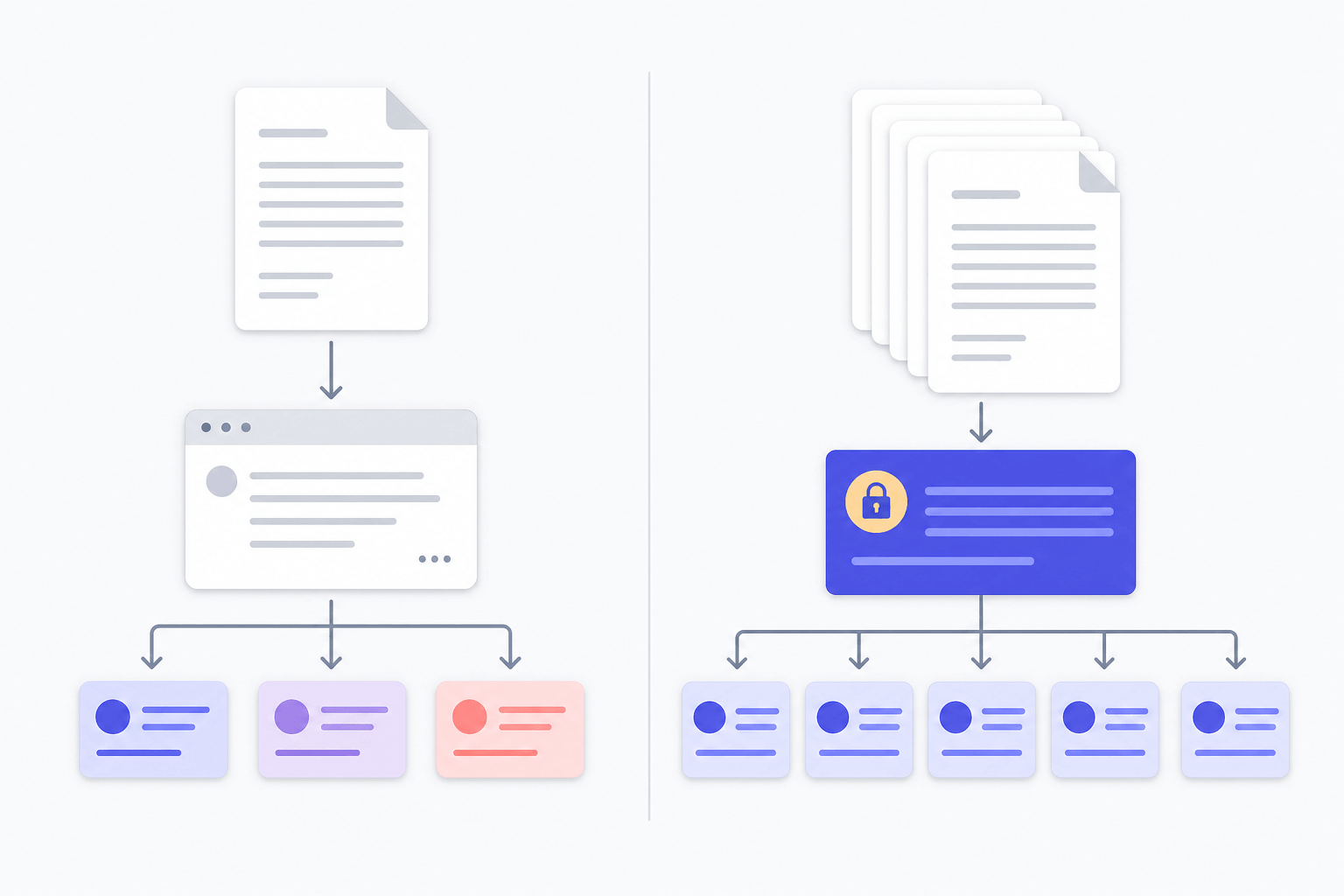
I want to be specific about what changes when you use a tool built for grading versus a general chatbot. Five things, roughly in order of how much they matter:
- The rubric is locked across the batch. One rubric, computed once, fed into every paper in the batch. ChatGPT in thirty separate windows derives the rubric afresh each time. We covered why this matters in the locked-rubrics post; in short, it is the single biggest difference between "AI graded the papers" and "AI graded the papers consistently."
- The output is structured, not prose. A dedicated tool gives you a spreadsheet you can edit, sort, and export to your gradebook. ChatGPT gives you a paragraph per student that you have to copy-paste. Across thirty students that is maybe forty minutes of pure friction.
- Per-question scores plus confidence flags. A grading tool can break a paper into question-level scores and tell you which calls it was uncertain about, so you focus your review where it matters. ChatGPT gives you a single overall impression and you have to ask it to elaborate.
- Edits are tracked, not lost. When you override the AI on question three, that edit is logged; the original AI score and your final score are both there. ChatGPT has no concept of teacher-edits-as-truth.
- No copy-paste tax. Photo of paper goes in, structured gradebook row comes out, CSV export ready for Google Sheets or your school’s gradebook system. No window-switching.
Where ChatGPT still wins, honestly
Three places I still reach for ChatGPT and would tell any teacher to do the same.
- Drafting feedback comments after grading. Once you have the score, ChatGPT is excellent at turning your three-bullet-point comment into a warm, parent-readable sentence. The score is anchored; the prose is the part the LLM is actually best at.
- Summarising what a student wrote. When a kid hands in a sprawling 1500-word essay and you need the gist in fifteen seconds, ChatGPT will give you that. Then you go in with informed eyes.
- Generating practice questions. If a kid is struggling with one concept and you need three more practice items by tomorrow, ChatGPT is faster than any worksheet generator. Just check the answers it gives.
Notice the pattern: in all three of those, the grade is not the artefact. ChatGPT is helping you do work around the score, not produce the score itself. That is where it is great, and where it is safe.
The five-paper test you can run yourself
I do not think you should take any blog post’s word for any of this, including mine. The good news is the test is cheap to run.
Pick five papers from a recent assignment you graded yourself. Score them in ChatGPT, then score them again in a dedicated grading tool of your choice. Then ask three questions:
- How close did each AI come to my own scores, on average?
- How close did each AI come to its own previous score when I re-ran the same paper?
- How long did each path take, including the time I spent verifying the output?
That third question is where most ChatGPT-based workflows quietly lose. You will see it in five papers. You do not need a research study to confirm it.
What this means in plain English
ChatGPT is the right tool for a lot of teacher work and the wrong tool for grading consistency at scale. The OECD numbers, the RAND data, and Flodén’s re-grading experiment all point at the same thing: teachers tried it, it inflates scores, it does not stay consistent paper to paper, and the supervision cost erases most of the time savings. The Education Week analysis of OpenAI’s recent ChatGPT-for-Teachers product called it, in the words of one cognitive-science critic, "the equivalent of a big digital nothingburger". That is harsher than I would put it. But the underlying observation, that a general chatbot is the wrong shape for the marking job, is right.
A dedicated tool with a locked rubric, structured output, and tracked teacher edits does the same job in half the time and half the worry. That is the entire pitch. And it is exactly the gap that made me build Grade Coach.
Sources cited above: Flodén (2025) British Educational Research Journal; OECD Digital Education Outlook 2026 and TALIS 2024 results; RAND Corporation, AI Use in Schools 2025; EdSurge interview, March 2026; Education Week analysis, December 2025.