
teacher life
International school first-year survival: paperwork is the part that gets you
Housing, visas, and culture shock get all the attention. The thing that broke me was paperwork: rubrics, reports, parent comms, and calendar prep in Vietnam, Korea, and China.
 Enzo · May 26, 2026 · 9 min read
Every veteran international-school teacher has the same first-year story. Mine was in Hanoi, August 2014, age 26. I had packed for the heat, downloaded Khan Academy onto a USB stick because I wasn't sure about Vietnamese internet, and rehearsed the four Vietnamese phrases I had practised on the plane. Orientation covered visas, housing, emergency contacts, and where to buy a SIM card. It skipped the rubrics, the parent meetings every 2 weeks, and the moment my GCSE training became useless because the school taught MYP. The teaching itself was fine. It was everything else that broke me.
I have since taught in three more countries and watched dozens of new colleagues hit the same wall in the same order. This is the memo I wish I had on my desk: a map of the paperwork shock that decides whether year 2 feels possible.
The numbers that explain why first year is so hard
It is not just you. The international-schools sector is structurally hard on first-year teachers. ISC Research's 2025 market report puts it bluntly: most international schools can only expect to retain teachers for one to six years, and the global staff number is now over 713,000 across the sector. Turnover is the baseline assumption, not an outlier. Some studies put the attrition rate as high as 60% in individual schools.
The reasons aren't usually "the country was hard." It's that the job, when you arrive, is recognizable in name only. You taught Year 9 English in London. You arrive in Hanoi to teach MYP Year 4 Language and Literature. The job title is the same. The rubric structure is foreign. The parent expectations are foreign. The accreditation cycle is foreign. The reporting platform is foreign. A 2024 peer-reviewed study in the Journal of Research in International Education followed British-trained teachers moving to MYP and described their first months as a phase of being "adrift" and in unsettled "survival mode." That is not weakness. That is the job.
The four paperwork piles that ate my first year
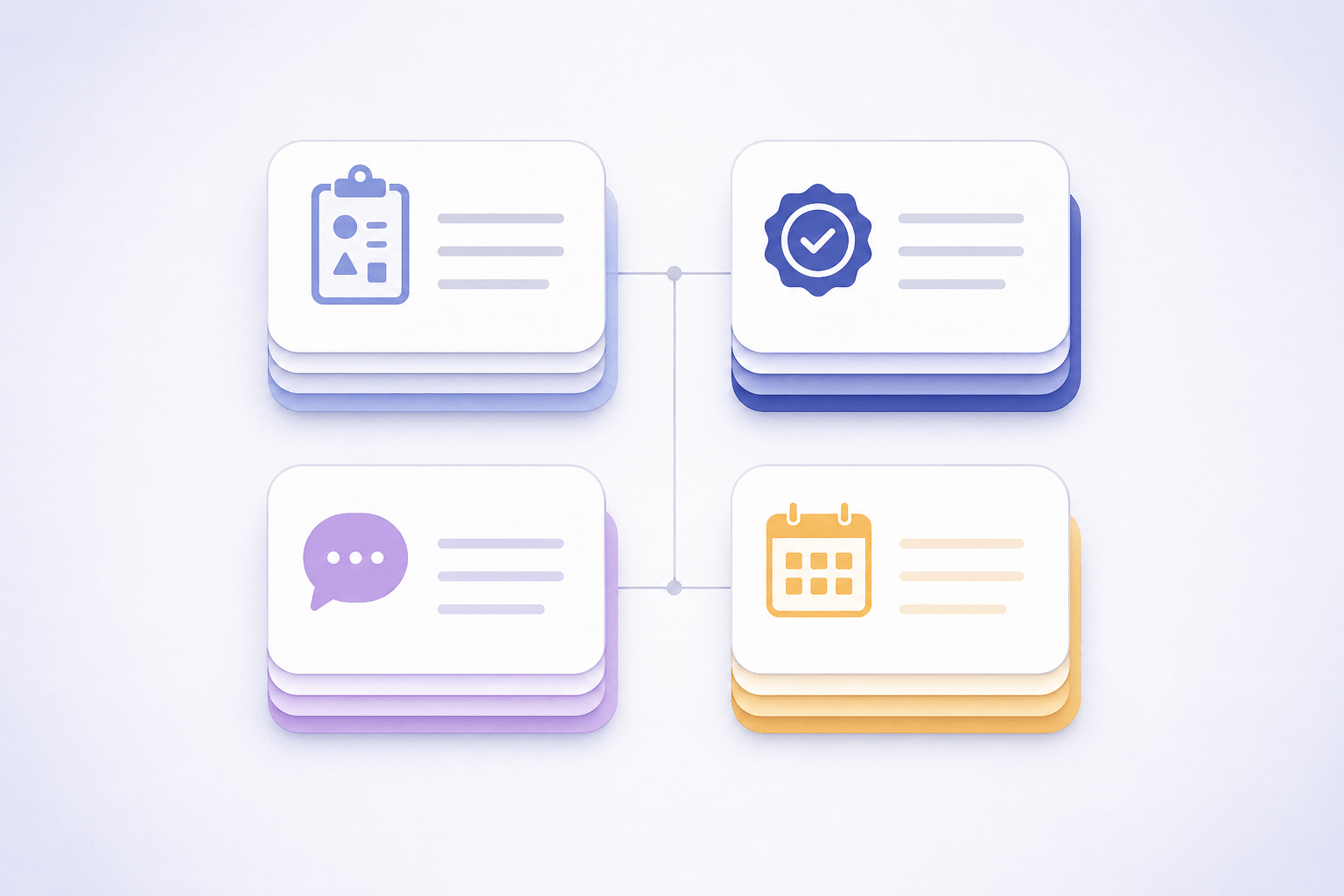
In retrospect, every single difficult thing in my first year fell into one of four paperwork piles. I did not know they existed when I started. They are now the first thing I tell new colleagues to map.
1. The curriculum-shift pile
If you are moving to IB, MYP, Cambridge, or AP from a national curriculum, your first three weeks will involve a quiet panic about how grades work. It is not just translation. The systems use different scales (1-7 in IB DP, 1-8 in MYP, A*-G in Cambridge IGCSE), different rubric philosophies (criterion-based vs points-based), and different reporting cycles. Allow yourself a full term to feel competent. Buy the coordinator a coffee in week one and ask them to walk you through the assessment framework, not just the syllabus. Most won't volunteer this; they assume you know.
2. The accreditation-evidence pile
International schools live and die by accreditation. CIS, WASC, NEASC, MSA, COBIS - whichever framework your school is in, every teacher contributes evidence to it. If you started after January 2025, you may be in the new CIS International Accreditation Framework, which has 18 standards across three dimensions and asks for "evidence" of well-being practices, learning culture, and "socially responsible learning community" artefacts. None of that was on the job ad. All of it shows up on your desk in October. Keep a folder from day one labelled accreditation evidence and drop screenshots, photos, and lesson plans into it as you go. Your future self will thank you.
3. The parent-communication pile
Nord Anglia leader Matt Payne wrote in Tes in April 2025 that "part of the work, when taking a post internationally, is adjusting to the increased parent communication and relationships". That is the polite version. The honest version is that fee-paying parents at an international school expect to know what's going on. Email response times shrink. Coffee meetings appear in your calendar. Reports require multilingual sensitivity. If you taught in a state school before, the cultural shift is bigger than the country shift. Plan for at least three to five hours a week on parent comms. It will not feel like teaching. It is teaching.
4. The "calendar" pile
International schools run more events than domestic schools. Open days. Gala nights. Three-way conferences. Subject fairs. House competitions. Curriculum mornings. Each one comes with prep tax (a slide deck, a hand-out, a duty rota) that rarely gets counted as teaching but somehow also isn't optional. Map your school's annual calendar in week two and pencil in the prep windows yourself, before they collide with everything else.
What I would actually do differently
Concretely, six things, in priority order:
- Book a one-hour walkthrough with a department veteran in your first week. Not the head of department; a regular teacher who has done this for two or more years. Buy them a coffee. Ask: "What does the year actually look like, month by month?" The calendar map you get will save you an order of magnitude more time than any onboarding session.
- Print the assessment criteria for every subject you teach. Stick them above your desk. MYP teachers, this is non-negotiable. The descriptors are abstract enough that you will misremember them in week three; having them in your eyeline makes "best fit" judgements three times faster.
- Build a one-page parent-comms template in week one. Subject line format, opening line, evidence section, closing. Reuse it. Customise three things per parent. Save yourself the cognitive cost of reinventing how to say "Sam is progressing well, here is one specific example, here is one thing he could work on" forty different times.
- Find one person outside your department to debrief with weekly. Ideally not someone in your subject area. Pastoral leads, librarians, and language teachers from other faculties are gold here. They're seeing your students through different lenses and will tell you things your subject team won't.
- Don't volunteer for anything in term one. Watch how the school actually operates before signing up for the school musical, the duke of edinburgh award trip, or the inter-school exchange programme. You will be invited because you are new and obviously enthusiastic. Most of these invitations are real commitments dressed up as "small extras."
- Keep an "I survived this" journal, even if just bullet points. Most of what you will think you learned in year one is invisible to you by year three. Writing it down means you can hand it to the next first-year colleague when they arrive.
The structural part that drains you
The hardest part of first year isn't any single pile. It's the absence of a coherent system that ties them together. Domestic schools usually have a single platform (PowerSchool, SIMS, Compass) where grades, parent comms, attendance, and curriculum mapping all live. International schools more often have three or four platforms, each owned by a different office, each with its own login, none of which talk to each other. ManageBac for assessment. SchoolsBuddy for events. Cloud-based report writers you learn by trial and error. The cognitive load of switching between them is the silent tax on your time, and it falls heaviest on first-year teachers because everyone else has built workarounds you haven't.
You can't solve that in your first year. What you can do is map it. Spend an hour in week two writing down every system you have to log into, what it's used for, and whose office owns it. Pin the map next to your desk. The mental friction of "where do I do X" is the friction; the friction shrinks the moment you have a map.
Why this gets better
Walker and Bunnell's 2024 study described first-year international teachers as moving through three phases: de-skilled, then re-skilled, then eventually settling into a state of "authenticity and freedom" that the participants described as the best phase of their teaching careers. The authors call it the re-skilling arc. It is real. It takes longer than you'll want it to. But the people who push through year one almost always say year three is the best year they've had as a teacher.
The first year is hard because every system is novel. The third year is good because every system has become a tool. The job hasn't changed. You have. That's the whole deal, and it's worth knowing about before you sign the contract.
Sources cited above: ISC Research 2025 international schools market report; Walker and Bunnell, Journal of Research in International Education, August 2024; Council of International Schools 2024 accreditation framework announcement; Matt Payne, Tes Magazine, April 2025; Tes / ISC Research sector trends, January 2026.